Knee osteoarthritis · Treatment comparison
GAE vs Genicular Nerve Ablation
Different targets. Different evidence. Compare benefits, risks and recovery—and the questions to ask before choosing care.
Van Nuys · Tarzana · Fountain Valley
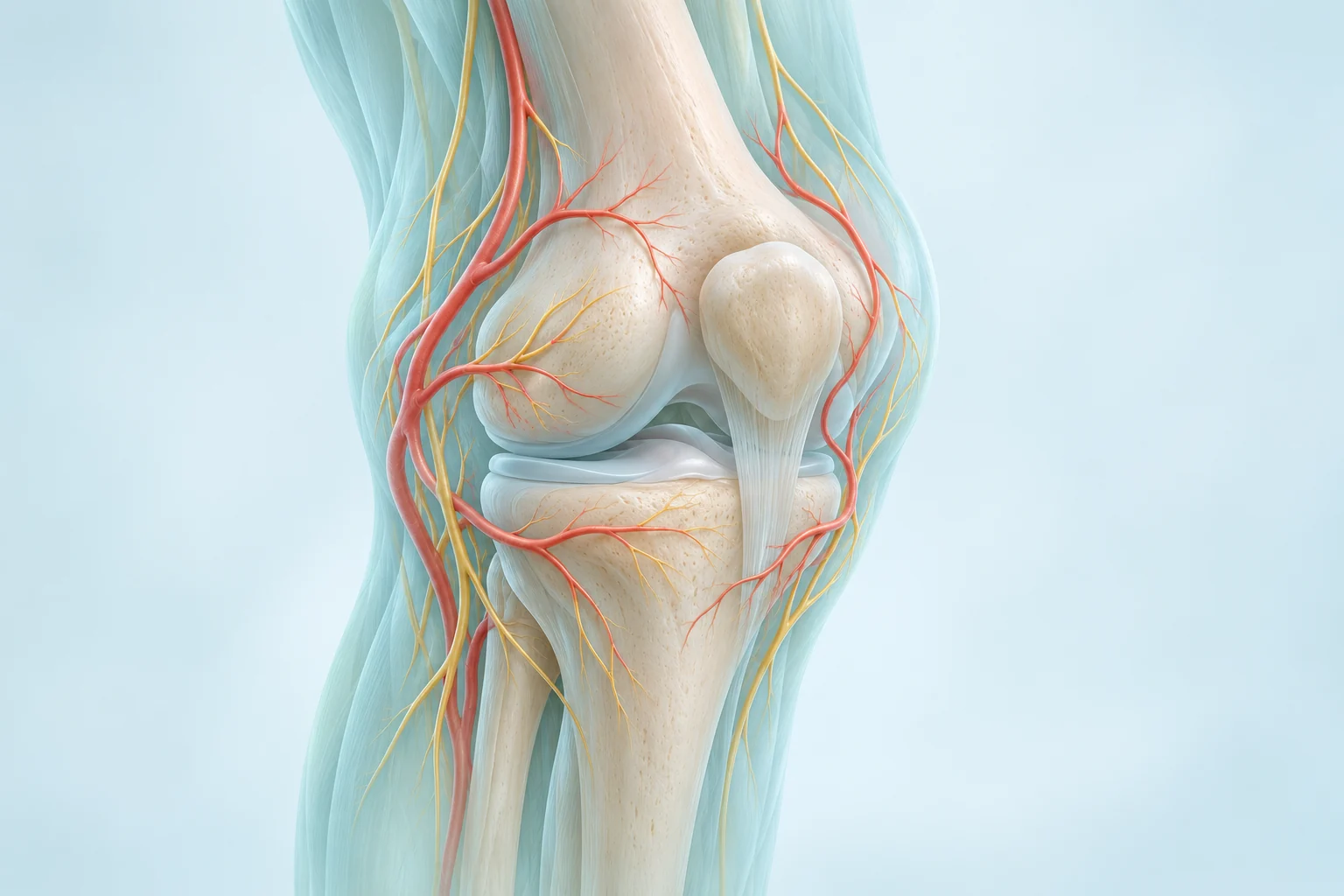
What is the difference between GAE and genicular nerve ablation? Genicular artery embolization (GAE) targets selected small arteries supplying inflamed tissue around the knee. Genicular nerve radiofrequency ablation (RFA) targets sensory nerves carrying knee pain signals. They address different contributors to pain; neither replaces worn cartilage or corrects joint alignment. The studies below do not establish that GAE is better than RFA.
For people with knee osteoarthritis whose symptoms persist despite appropriate nonsurgical care, the next decision is often whether to consider an intervention, continue conservative care or discuss knee replacement. A diagnosis and a review of prior treatment should come before choosing between these procedures.
GAE vs genicular nerve RFA at a glance
| Question | GAE | Genicular nerve RFA |
|---|---|---|
| What is targeted? | Selected arteries associated with inflammation around the knee. | Sensory nerves that transmit pain signals from the knee. |
| How is it performed? | An interventional radiologist uses an arterial catheter, contrast and X-ray guidance to deliver embolic particles. | A clinician uses image-guided needles and radiofrequency energy to treat selected sensory nerves. |
| How is candidacy assessed? | The diagnosis, knee imaging, previous care, vascular anatomy and medical risks are reviewed. | The diagnosis and previous care are reviewed; a diagnostic nerve block may help assess suitability. |
| What can it change? | It may reduce pain in selected patients; response and durability vary. | It may reduce pain; the effect may lessen as nerves recover. |
| Does it repair arthritis? | It does not restore lost cartilage. | It does not restore lost cartilage. |
| What comes afterward? | Follow-up, activity guidance and continued arthritis management. | Follow-up, activity guidance and continued arthritis management. |
GAE is the procedure evaluated by SoCal Interventional. Genicular nerve ablation is a different service; discussing it here does not mean our practice performs it. Your clinician may recommend a pain specialist, orthopedist or another treating team.
What does the evidence actually show?
GAE: promising results, with important uncertainty
In a 2024 randomized trial of 58 people, GAE did not show a statistically significant pain advantage over a sham procedure at four months. Both groups improved. A small 2026 randomized study comparing GAE with standard management reported improvement, but its different comparator does not resolve the sham-controlled result or establish superiority over RFA. 2024 sham-controlled trial; 2026 standard-management trial.
Professional guidance also differs. The Society of Interventional Radiology's 2026 position supports GAE for selected patients after conservative treatment has failed, including people wishing to delay or unable to undergo knee replacement. The 2026 VA/DoD osteoarthritis guideline gives a weak recommendation against GAE. NICE guidance in the United Kingdom restricts GAE to research because of uncertainty about efficacy and long-term safety. These are different assessments of the evidence, not a promise of benefit or a universal prohibition. SIR position; VA/DoD guideline, recommendation 24; NICE GAE guidance.
RFA: evidence for pain relief, not a cure for arthritis
A randomized trial of 151 patients found cooled RFA produced better six-month pain outcomes than an intra-articular steroid injection. That comparison was not against GAE. NICE considers the evidence for short-term pain relief sufficient to use radiofrequency denervation with appropriate clinical governance, consent, audit and clinician training. Results from one technique or study should not be treated as a guarantee for every patient. Cooled RFA trial; NICE RFA guidance.
A useful consultation question: “What evidence applies to my knee, and how likely am I to need another treatment?” Comparing response percentages from unrelated studies can be misleading because patients, techniques and outcome measures differ.
Who should discuss each option?
Assessment should establish whether osteoarthritis explains the pain and whether exercise-based rehabilitation, weight management when appropriate, medication or other recommended care has been adequately tried. Imaging severity alone does not choose the procedure. Mechanical symptoms, instability, inflammatory disease, infection or pain from another location may require a different approach.
For GAE, the interventional radiologist reviews arterial access, contrast-related risks, kidney function, bleeding risk and the expected benefit. For RFA, the treating clinician may use the response to a diagnostic nerve block alongside the overall assessment; a successful block does not guarantee lasting relief. Royal College of Anaesthetists: nerve blocks and denervation.
Risks, recovery and the next step
GAE can involve arterial-access bruising or bleeding, transient discomfort, contrast reactions, radiation exposure and unintended embolization affecting nearby tissue, including skin. RFA can cause procedure-site pain, altered sensation or nerve irritation; infection, bleeding and thermal injury are additional considerations. The treating team should explain the risks of the specific technique and how complications are managed. GAE guidance; RFA guidance.
Both may be performed as outpatient procedures, but time off work, driving and exercise restrictions depend on sedation, access site, technique, symptoms and your job. Ask for written recovery instructions rather than assuming identical downtime. Neither procedure automatically removes the future need for joint replacement.
Confirm coverage and out-of-pocket costs for the specific procedure with your insurer and treating practice. Coverage for one knee procedure does not establish coverage for another.
Common questions
Is genicular artery embolization the same as nerve ablation?
No. GAE targets selected arteries; radiofrequency ablation targets sensory nerves. The evaluation, equipment, risks and evidence differ.
Which works better for knee osteoarthritis?
The studies discussed here do not establish that one is better than the other. Ask which evidence fits your diagnosis, prior care and goals, including whether an orthopedic assessment is more appropriate.
Can either treatment regrow knee cartilage?
Neither should be presented as a treatment that regrows lost cartilage. Pain improvement does not mean the underlying arthritis has been reversed.
Can I have GAE after a nerve ablation?
Prior treatment does not by itself establish candidacy. An assessment must review the cause of persistent pain, response to previous treatment, imaging and medical risks.
Continue your knee-treatment research
GAE treatment, candidacy and recovery · Who may be a GAE candidate?
A suddenly hot, swollen knee with fever or a new inability to bear weight needs prompt medical assessment, rather than an online consultation request.