Persistent symptoms
People with symptomatic knee osteoarthritis despite appropriate conservative care may discuss an evaluation. The treatment history should include exercise-based rehabilitation and other suitable measures.
Los Angeles & Orange County · GAE care
Explore an image-guided procedure for knee osteoarthritis pain. Compare candidacy, recovery and the evolving evidence with your other treatment options.
Van Nuys · Tarzana · Fountain Valley
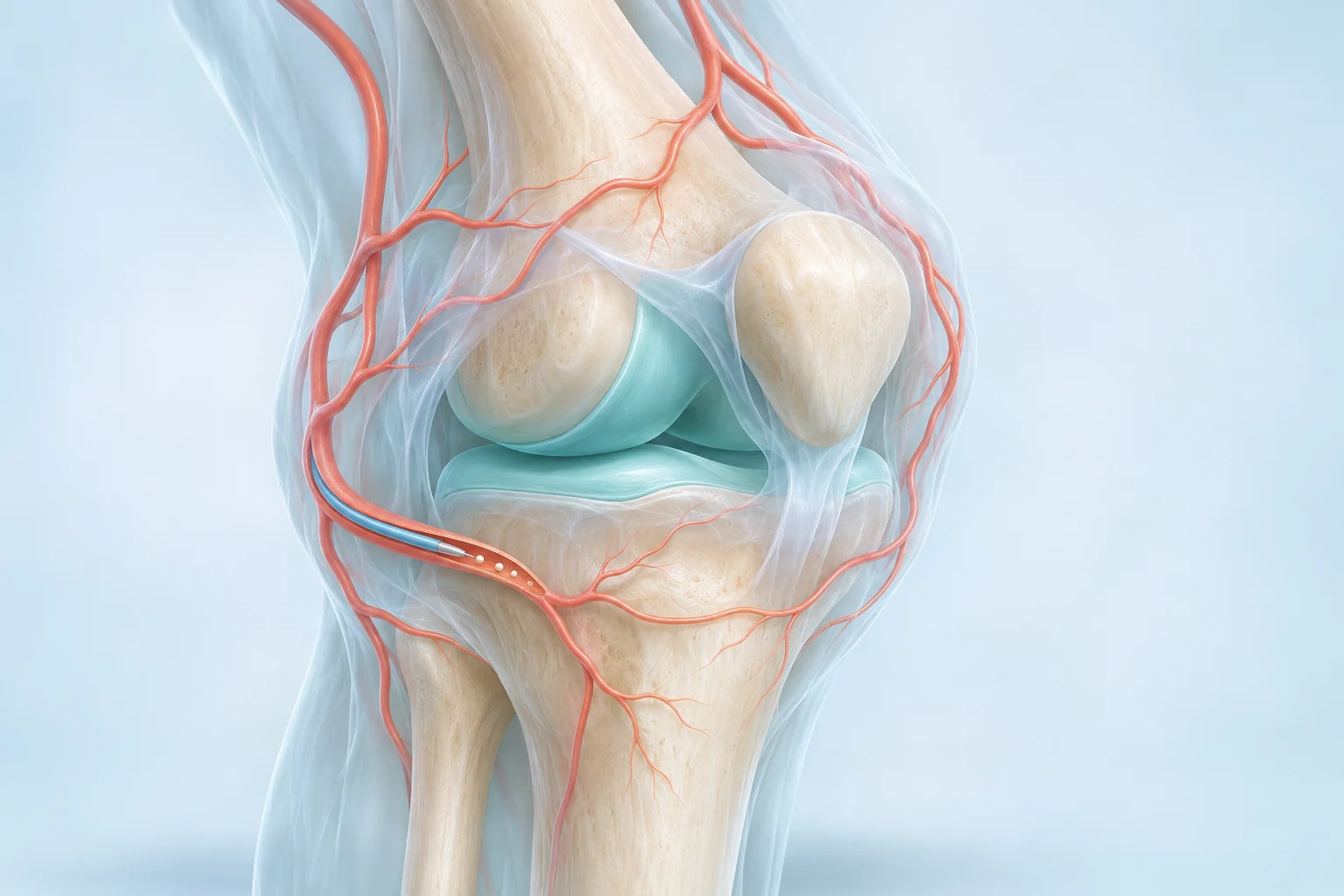
How can GAE help knee pain? GAE targets selected small arteries associated with inflamed tissue around an arthritic knee. Reducing this abnormal blood supply may reduce pain in some patients. It does not regrow cartilage, correct joint alignment or cure osteoarthritis, and meaningful benefit is not assured.
An interventional radiologist uses an arterial catheter, contrast and X-ray guidance to identify and treat appropriate vessels. This is different from genicular nerve radiofrequency ablation, which treats nerves carrying pain signals.
The first step is establishing whether knee osteoarthritis explains the pain. A meniscal injury, inflammatory arthritis, infection, instability or pain referred from the hip or back may require a different evaluation.
Compare GAE with genicular nerve ablation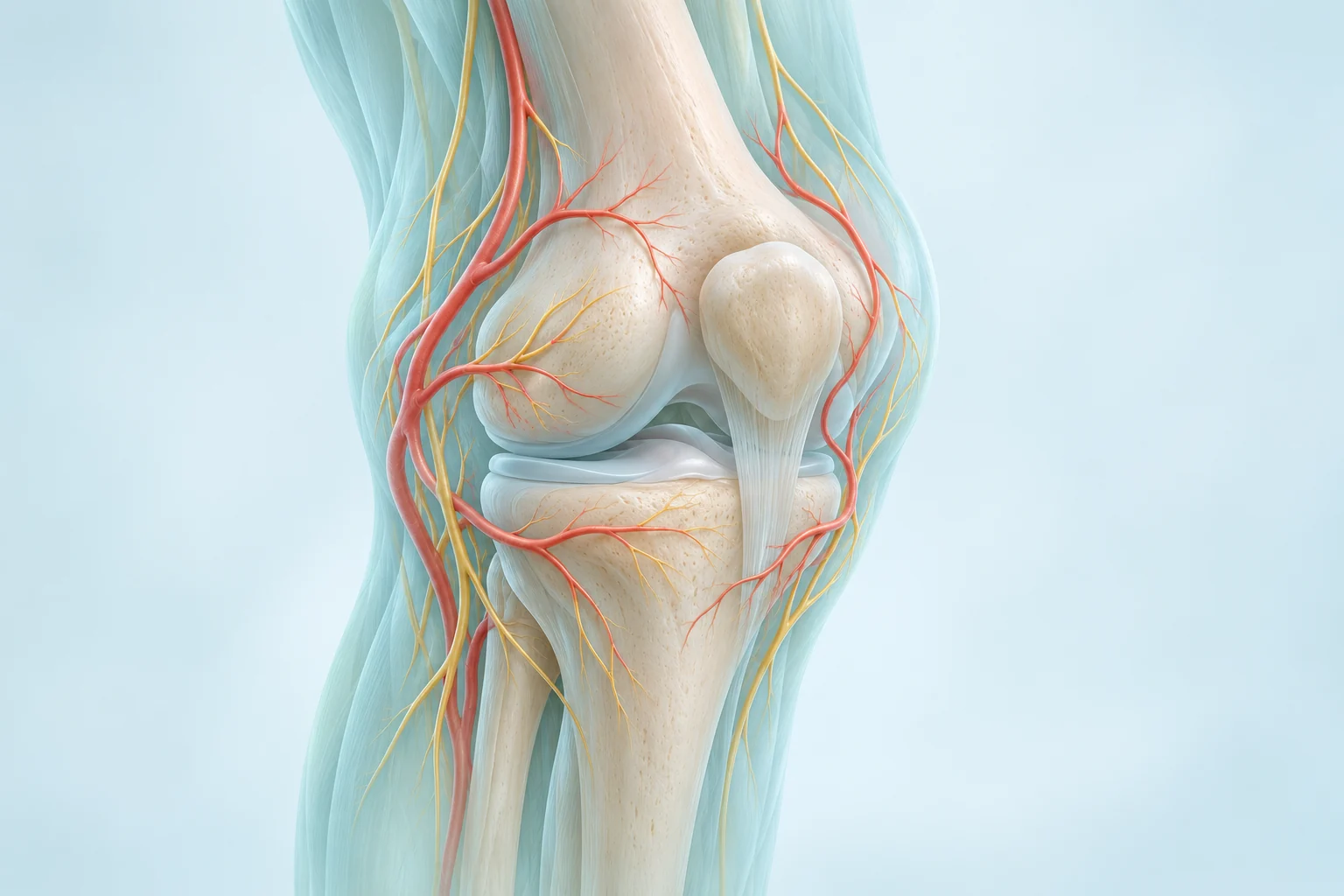
People with symptomatic knee osteoarthritis despite appropriate conservative care may discuss an evaluation. The treatment history should include exercise-based rehabilitation and other suitable measures.
Knee imaging, pain pattern, function, prior injections or procedures and examination findings help determine whether GAE deserves consideration. Imaging severity alone cannot make that decision.
The clinician reviews arterial disease, kidney function, contrast allergy, infection and bleeding risk. Severe mechanical problems or another diagnosis may make orthopedic or other care more appropriate.
A wish to delay knee replacement is a reason to discuss options, not proof that GAE will delay or prevent surgery. Ask what evidence applies to your knee and how the result will be measured.
Start with knee osteoarthritis treatment choices in Van Nuys to compare conservative care, injections, orthopedic evaluation and GAE.
| Option | What it does | What to consider |
|---|---|---|
| Exercise and other conservative care | Support strength, function and symptom management; medication and weight management may be appropriate. | Remain part of long-term osteoarthritis care even when a procedure is considered. |
| Knee injections | May relieve symptoms for a period of time, depending on the treatment. | Benefit and risks vary; repeated treatment is not automatically the right next step. |
| Genicular nerve RFA | Treats selected sensory nerves carrying pain signals. | A different procedure from GAE, with different evidence and selection criteria. |
| GAE | Targets selected arteries supplying inflamed tissue. | Evidence remains mixed; it does not repair worn cartilage or correct deformity. |
| Knee replacement | Replaces damaged joint surfaces. | May be appropriate for advanced disease with substantial symptoms after other care; requires surgical assessment and rehabilitation. |
Related guide: How to read GAE reviews and sham-controlled trial results.
Studies do not all reach the same conclusion. A 2024 randomized trial of 58 people found no statistically significant pain advantage over a sham procedure at four months; both groups improved. A small 2026 randomized study reported improvement compared with standard management, but that comparator does not resolve the sham-controlled finding.
2024 sham-controlled trial · 2026 standard-management trial.
Guidance also differs. SIR’s 2026 position supports GAE for selected patients whose conservative treatment has failed, including those unable or wishing to delay knee replacement. The 2026 VA/DoD osteoarthritis guideline gives a weak recommendation against GAE. NICE guidance in the United Kingdom restricts its use to research because of uncertainty about efficacy and long-term safety.
SIR position statement · VA/DoD guideline, recommendation 24 · NICE guidance.
What should that mean for your decision? Ask how likely you are to experience meaningful improvement, what remains uncertain, and what the plan is if pain continues. The studies discussed here do not establish that GAE is better than nerve ablation or knee replacement.
Bring imaging and records of physical therapy, medicines, injections and prior procedures. The clinician assesses the diagnosis, goals and reasons other treatments have not helped enough.
If appropriate, discuss arterial access, sedation, contrast, embolic material and the procedure facility. Review medication instructions and arrange transportation if sedation is planned.
The team assesses pain and function after treatment and continues an arthritis-management plan. A procedure is not a substitute for follow-up or appropriate rehabilitation.
Plan your questions about walking, work and follow-up with our detailed GAE recovery guide.
GAE may be performed as an outpatient procedure. Recovery instructions depend on the access site, sedation, symptoms, medical history and type of work. Ask when you can drive, lift, exercise or return to work; there is no single timetable that applies to everyone.
Access-site soreness or bruising and temporary discomfort can occur. If pain relief occurs, it may evolve over time. Keep a record of walking tolerance, daily activity and pain rather than judging success only by the first few days.
Can GAE prevent a future knee replacement? That cannot be promised. Persistent symptoms, advancing arthritis or mechanical limitations may still require orthopedic treatment. Discuss any later surgery with both the orthopedic and embolization teams.
Risks include arterial-access bleeding or bruising, infection, vessel injury, contrast reaction, kidney injury and radiation exposure. Unintended embolization can affect nearby tissue, including skin; the specific technique and material matter. The consultation should address your individual risks and what would happen if symptoms did not improve.
Seek prompt medical assessment for a suddenly hot, swollen knee with fever, new inability to bear weight, or severe worsening symptoms. After treatment, follow urgent instructions for bleeding, worsening limb pain, skin changes or other concerning symptoms.
Meet with Nathanael Sabbah, MD to discuss your diagnosis, previous treatment and goals. Our consultation locations serve patients across the San Fernando Valley and Orange County. Confirm the consultation address and procedure facility when scheduling; they may be different.
15211 Vanowen Street, Suite 305, Van Nuys, CA 91405. View Van Nuys office
18370 Burbank Boulevard, Suite 514, Tarzana, CA 91356. View Tarzana office
10900 Warner Avenue, Suite 101A, Fountain Valley, CA 92708. View Fountain Valley office
Who performs embolization? An interventional radiologist evaluates and treats the relevant arteries using imaging guidance. Dr. Sabbah’s Cedars-Sinai provider profile lists his training and board certifications. Your consultation should cover the planned technique, alternatives, risks and follow-up—not just the procedure name.
Ask why GAE is being considered for your knee, which evidence applies to you, what alternatives remain and how follow-up would be arranged. Bring the same questions to each consultation and keep the answers with your appointment notes.
Review the GAE study summaries and their limitations and the treatment alternatives. These questions help organize the conversation; this page cannot choose a treatment for you.
To meet with Dr. Nathanael Sabbah in Los Angeles, use the Van Nuys and Tarzana GAE consultation guide. See the GAE cost and insurance questions before requesting plan-specific checks. Ask the office how to transfer records securely.
Request a GAE consultationCoverage and out-of-pocket cost depend on the specific plan, medical-necessity criteria, authorization, clinician and facility. An office accepting an insurance plan does not establish that the procedure is covered. Ask for verification and an estimate before scheduling treatment.
Bring imaging reports, your medication and allergy lists, previous procedure records and your main questions. Do not stop prescribed medicines without instructions from your treating team.
No. GAE treats selected arteries associated with inflammation; genicular nerve radiofrequency ablation treats sensory nerves carrying pain signals. Their evaluation, risks and evidence differ.
No. GAE should not be described as a cartilage-regrowth treatment or a cure for osteoarthritis. Pain improvement does not mean the underlying joint damage has been reversed.
Candidacy requires a confirmed diagnosis, review of imaging and previous treatment, and assessment of vascular and medical risks. Persistent osteoarthritis pain after appropriate conservative care may prompt evaluation, but does not automatically establish eligibility.
Evidence is mixed. Some studies report improvement, while a sham-controlled trial did not demonstrate a significant pain advantage at four months. Professional guidelines differ, so the uncertainties should be part of consent.
A limited response to injections can prompt reassessment, but it does not establish GAE candidacy. The cause of pain, imaging, rehabilitation history and alternatives should be reviewed first.
Durability varies and meaningful relief is not assured. Ask which studies fit your condition, how pain and function will be followed, and what other treatment may be needed if symptoms persist or return.
Coverage is plan-specific and may depend on medical-necessity criteria or whether a plan considers the procedure investigational. Confirm authorization and out-of-pocket cost for the exact procedure and facility.
SoCal Interventional offers evaluations in Van Nuys, Tarzana and Fountain Valley. Call (310) 929-0026 or use the nonurgent appointment form, and confirm the location when scheduling.
Editorially updated November 4, 2026. Prepared by the SoCal Interventional Editorial Team using the clinical sources linked on this page. Educational information does not replace an individual medical evaluation. Read our editorial policy.
Use the appointment form below for a nonurgent consultation, or call (310) 929-0026.
Physician information: Nathanael Sabbah, MD, interventional radiologist.
SoCal Interventional Encino
16250 Ventura Blvd, Suite 160, Encino, CA 91436
PAE, GAE and UFE consultations are planned. Hours from opening: Monday–Friday, 8:00 AM–5:00 PM. This office is not yet open; Tarzana, Van Nuys and Fountain Valley remain available. Confirm the address for each appointment; your procedure facility may differ.
Encino office details · (310) 929-0026 · Ask about appointment availability