Uterine health · Understanding your diagnosis
Fibroids vs Adenomyosis
Similar symptoms can have different causes. Understand the diagnosis, imaging and treatment questions to discuss before choosing a procedure.
SoCal Interventional · Los Angeles & Orange County
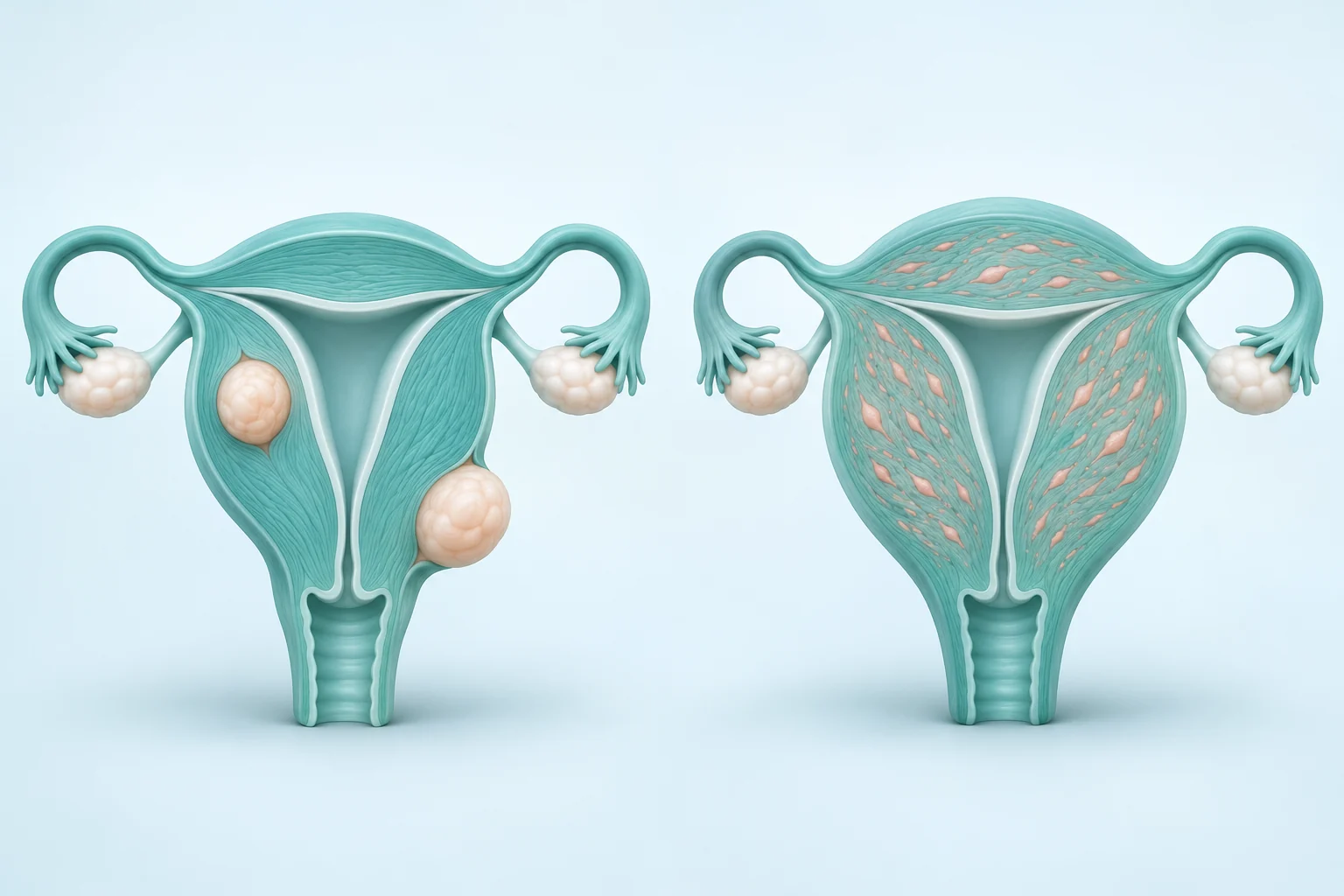
What is the difference between fibroids and adenomyosis? Fibroids are benign growths made from uterine muscle and connective tissue. Adenomyosis involves endometrial-type tissue within the uterine muscle. They can produce overlapping symptoms and can coexist, but they are different conditions. Imaging and gynecologic assessment help determine what is contributing to symptoms.
Fibroids vs adenomyosis at a glance
| Question | Uterine fibroids | Adenomyosis |
|---|---|---|
| What is affected? | Discrete growths in, on or near the uterine cavity and wall. | Endometrial-type tissue within the uterine muscle; the pattern can be diffuse or localized. |
| What symptoms may occur? | Heavy bleeding, pressure, fullness or symptoms related to a fibroid’s size and location. | Painful or heavy periods, pelvic pain and sometimes an enlarged, tender uterus. |
| Can symptoms overlap? | Yes. Symptoms alone do not reliably distinguish the conditions. | Yes. Fibroids, endometriosis and other conditions may also be present. |
| How are they assessed? | History, examination and imaging, with further testing when indicated. | History, examination and ultrasound or MRI interpreted in clinical context. |
| Does a scan automatically mean treatment? | No. Symptoms, findings and goals determine whether treatment is needed. | No. An imaging finding without symptoms does not automatically require treatment. |
These are broad distinctions, not a diagnostic checklist. ACOG’s fibroid overview and UCLH’s adenomyosis guide explain the different tissue changes. A localized area of adenomyosis can be more difficult to distinguish from a fibroid than a simplified illustration suggests.
Why the symptoms can feel similar
Both conditions can be associated with heavy or painful periods. Pressure, bloating and pain can have other explanations as well, and more than one condition may be contributing. Heavy bleeding can also cause anemia, which needs its own assessment. Do not assume a known fibroid explains every new symptom. NHS adenomyosis overview; FDA fibroid information.
Adenomyosis is also different from endometriosis. In endometriosis, tissue similar to the uterine lining is found outside the uterus. These conditions can overlap, so treatment directed at the uterus may not address every source of pelvic pain. NHS: endometriosis.
How ultrasound and MRI help clarify the diagnosis
Ultrasound is often the first imaging examination. MRI can add information when the findings are unclear or treatment planning requires a more detailed view. The aim is to understand the fibroid locations, uterine wall and other potential causes of symptoms—not simply count abnormalities. UCLH: diagnosis of adenomyosis.
Bring the imaging report and, when requested, the actual images. A useful consultation question is: “Which findings are most likely to explain my bleeding, which explain pressure or pain, and what remains uncertain?” Also describe bleeding between periods, pain with sex and any recent change in symptoms. NHS: symptoms and evaluation.
Can you have fibroids and adenomyosis together? Yes. When both are present, ask whether the proposed treatment is expected to help symptoms from each condition. Removing one fibroid does not necessarily resolve symptoms from diffuse adenomyosis, and treating uterine blood supply does not guarantee relief of every type of pelvic pain.
Treatment starts with symptoms and your goals
For fibroids, observation, medicines, embolization and surgery may all enter the discussion. Myomectomy removes fibroids while retaining the uterus; hysterectomy removes the uterus. The number, size and position of fibroids and pregnancy goals affect the options. FDA treatment overview.
For adenomyosis, symptom-directed options can include medicines for pain or heavy bleeding and hormonal treatment, including an intrauterine system when appropriate. Some patients discuss uterine artery embolization or surgery. Hysterectomy is a definitive treatment for adenomyosis in the uterus, but it ends the ability to carry a pregnancy and requires a surgical discussion. UCLH treatment options.
There is no single best choice based only on the diagnosis name. Ask how the recommendation balances bleeding control, pain, recovery, reproductive goals and the possibility of another treatment later.
Can embolization treat adenomyosis as well as fibroids?
Uterine fibroid embolization (UFE) is the fibroid-focused name for an approach also called uterine artery embolization (UAE). UAE can be considered for selected patients with adenomyosis, but fibroid outcomes should not be assumed to apply unchanged to adenomyosis.
NICE guidance supports UAE for symptom relief in a substantial proportion of selected patients with adenomyosis, while emphasizing that symptoms may persist or return and additional procedures may be required. It recommends selection involving both gynecology and interventional radiology, and identifies uncertainty about fertility. This is guidance about the procedure, not proof of suitability for a particular patient. NICE: UAE for adenomyosis.
If your scan mentions both conditions, ask the reviewing clinicians which symptoms embolization is expected to address, what limitations apply and what follow-up would involve. A gynecologic evaluation remains important before deciding on an arterial procedure.
Discuss pregnancy plans before selecting treatment
Keeping the uterus and preserving fertility are separate goals. The reproductive implications of adenomyosis, fibroid location and any proposed procedure need individual counseling. Tell the team if you hope to conceive, might want pregnancy later or are unsure.
For fibroid treatment, the FEMME trial’s reproductive analysis had too few pregnancies to reliably determine which approach—UAE or myomectomy—produced better reproductive outcomes. That uncertainty should not be converted into a claim that the procedures are equivalent, or extrapolated to adenomyosis. FEMME reproductive-outcomes analysis.
Questions to take to your appointment
- Does the imaging suggest fibroids, adenomyosis or both?
- Which finding best explains my main symptom?
- Do I need anemia treatment or additional gynecologic testing?
- How would each option affect my pregnancy plans?
- What is the plan if bleeding or pain continues?
Seek prompt care for severe or worsening pelvic pain or heavy bleeding with dizziness, fainting or shortness of breath. New bleeding after menopause also needs medical evaluation rather than an assumption that it is from previously diagnosed fibroids.
Common questions
Are fibroids and adenomyosis the same condition?
No. Fibroids are discrete benign uterine growths. Adenomyosis involves endometrial-type tissue within the uterine muscle. They may cause similar symptoms and can occur together.
Can symptoms alone tell me which condition I have?
No. Heavy bleeding, painful periods and pelvic pressure can overlap with other conditions. History, examination and appropriate imaging help clarify the diagnosis.
Is MRI always required?
Not always. Ultrasound is often the first test. MRI may help when the findings are uncertain or more detail would change treatment planning. Your clinician should explain why a particular test is needed.
Does removing a fibroid cure adenomyosis?
Not necessarily. Myomectomy removes fibroids, while adenomyosis may involve a broader area of uterine muscle. Ask whether a proposed procedure is expected to address each source of symptoms.
Can UAE be considered for adenomyosis?
It can be considered in selected patients after appropriate gynecologic and interventional radiology review. Symptoms may persist or recur, another procedure may be needed, and effects on fertility remain uncertain.
Does uterus-preserving treatment guarantee fertility?
No. Retaining the uterus does not establish the chance of conception or the safety of a future pregnancy. Discuss reproductive goals and treatment-specific uncertainties before choosing care.
Plan your next conversation
SoCal Interventional offers fibroid embolization evaluations with Nathanael Sabbah, MD in Van Nuys, Tarzana and Fountain Valley. Bring your imaging and gynecologic records. If adenomyosis is suspected, clarify the diagnosis and available treatment pathways with the appropriate specialists.