Knee osteoarthritis · Treatment comparison
GAE vs Genicular Nerve Ablation
Different targets. Different evidence. Compare benefits, risks and recovery—and the questions to ask before choosing care.
Van Nuys · Tarzana · Fountain Valley
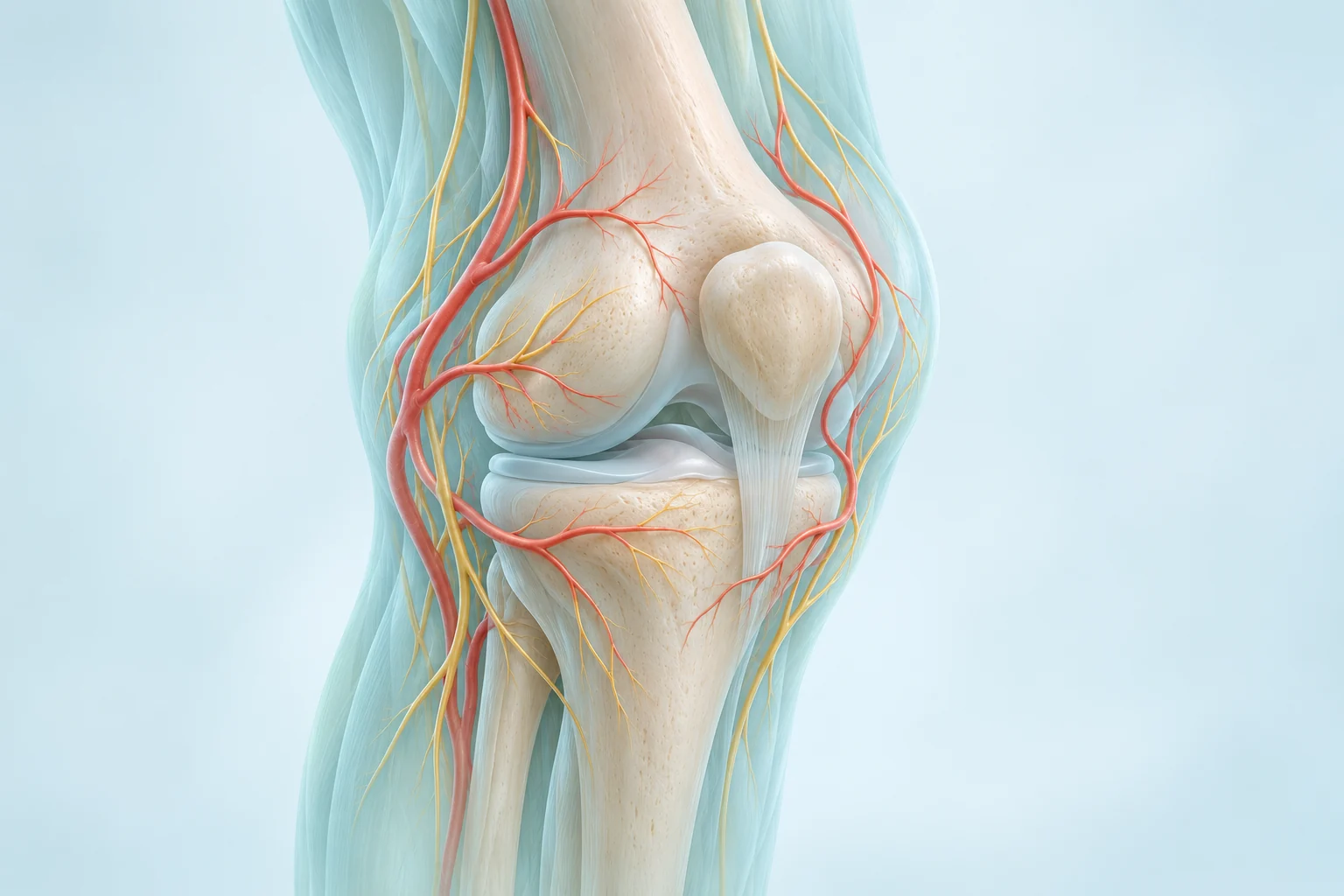
What is the difference between GAE and genicular nerve ablation? GAE treats selected arteries near the knee. Nerve ablation uses radiofrequency energy, or RFA, to treat nerves that carry pain signals. Neither rebuilds cartilage or fixes joint alignment. The studies below do not show that GAE works better than RFA.
If knee arthritis pain persists, review what you have tried and what helped. The next step may be more nonsurgical care, a procedure or knee replacement. First, confirm the cause of the pain. Then compare options that fit your knee and your goals.
GAE vs genicular nerve RFA at a glance
| Question | GAE | Genicular nerve RFA |
|---|---|---|
| What is targeted? | Selected arteries associated with inflammation around the knee. | Sensory nerves that transmit pain signals from the knee. |
| How is it done? | An interventional radiologist uses an arterial catheter, contrast and X-ray guidance to deliver tiny particles. | A clinician uses image-guided needles and radiofrequency energy to treat selected sensory nerves. |
| How is candidacy assessed? | The diagnosis, knee imaging, previous care, vascular anatomy and medical risks are reviewed. | The diagnosis and previous care are reviewed; a diagnostic nerve block may help assess suitability. |
| What can it change? | It may reduce pain in selected patients; response and durability vary. | It may reduce pain; the effect may lessen as nerves recover. |
| Does it repair arthritis? | It does not restore lost cartilage. | It does not restore lost cartilage. |
| What comes afterward? | Follow-up, activity guidance and continued arthritis management. | Follow-up, activity guidance and continued arthritis management. |
GAE is the procedure evaluated by SoCal Interventional. Genicular nerve ablation is a different service; discussing it here does not mean our practice performs it. Your clinician may recommend a pain specialist, orthopedist or another treating team.
What does the evidence actually show?
GAE: promising results, with important uncertainty
A 2024 trial enrolled 58 people. At four months, GAE did not show a clear pain advantage over a sham procedure. Both groups improved. A small 2026 trial reported benefit compared with standard care. That study used a different comparison. It does not settle the sham-trial finding or show that GAE is better than RFA. 2024 sham-controlled trial 2026 standard-management trial
Expert groups also differ. SIR supports GAE for selected people after other care has failed. This can include people who wish to delay knee replacement or cannot have it. The 2026 VA/DoD guideline gives a weak recommendation against GAE. NICE in the UK limits GAE to research because benefit and long-term safety remain uncertain. Discuss what these views mean for your own care. SIR position VA/DoD guideline, recommendation 24 NICE GAE guidance
RFA: evidence for pain relief, not a cure for arthritis
A trial of 151 people compared cooled RFA with a steroid injection into the knee. RFA gave better pain relief at six months. The trial did not compare RFA with GAE. NICE supports RFA for short-term pain relief with trained clinicians, consent and checks on care. A study result cannot promise the same relief for you. Cooled RFA trial NICE RFA guidance
A useful visit question: “What evidence applies to my knee, and how likely am I to need another treatment?” Comparing response percentages from unrelated studies can be misleading because patients, techniques and outcome measures differ.
Who should discuss each option?
First, check whether arthritis is causing the pain. Review exercise, physical therapy, weight care when needed, medicines and other treatments tried. A scan alone does not choose the next step. A knee that gives way, infection, another joint disease or pain from elsewhere may need different care.
For GAE, the interventional radiologist reviews access to an artery, contrast-related risks, kidney function, bleeding risk and the expected benefit. For RFA, the treating clinician may use the response to a diagnostic nerve block alongside the overall review; a successful block cannot guarantee lasting relief. Royal College of Anaesthetists: nerve blocks and denervation.
Risks, recovery and the next step
GAE can cause bruising or bleeding at the artery entry site, short-term pain and a reaction to contrast dye. It uses radiation. Particles can also reach nearby tissue, including skin, and cause harm. RFA can cause pain at the needle site, changes in feeling or nerve irritation. Infection, bleeding and heat injury are other risks. Ask the team to explain the risks of the exact method offered. GAE guidance RFA guidance
Both may be done as outpatient procedures, but time off work, driving and exercise restrictions depend on sedation, access site, technique, symptoms and your job. Ask for written recovery instructions rather than assuming identical downtime. Neither procedure automatically removes the future need for joint replacement.
Confirm coverage and out-of-pocket costs for the specific procedure with your insurer and treating practice. Coverage for one knee procedure does not show coverage for another.
Common questions
Is genicular artery embolization the same as nerve ablation?
No. GAE targets selected arteries; radiofrequency ablation targets sensory nerves. The review, equipment, risks and evidence differ.
Which works better for knee osteoarthritis?
The studies discussed here do not establish that one is better than the other. Ask which evidence fits your diagnosis, past care and goals, including whether an orthopedic review is a better fit.
Can either treatment regrow knee cartilage?
Neither should be presented as a treatment that regrows lost cartilage. Pain improvement does not mean the underlying arthritis has been reversed.
Can I have GAE after a nerve ablation?
Past treatment does not by itself establish candidacy. A review must review the cause of persistent pain, response to past treatment, imaging and medical risks.
Continue your knee-treatment research
GAE treatment, candidacy and recovery · Who may be a GAE candidate?
A suddenly hot, swollen knee with fever or a new inability to bear weight needs prompt medical review, rather than an online visit request.